
Kelly Narowitz art educator/artist
Elementary School: Origami Project
The Art Of Following Instructions
Teaching Intern(s): Kelly Narowitz
School: Mark Murray Elementary School (University Prep Academy, Detroit)
Grade Level & Content Area: 4th Grade Art (with Math cross curricular content)
Lesson Title: Origami
Time Needed for Lesson: Three hours/class periods
Learners & Learning Environment:
Engaging and Supporting Diverse Learner
Demographics: The entire class population consists of all African American students from the urban Detroit area. The class is approximately 50% male and 50% female. All of the students speak English and have no other linguistic background. There are no special needs children in this class.
Accommodations and Adaptations:
Students need instructional support by modeling expected outcomes and behaviors because they have demonstrated the need to visually and kinetically learn. The teacher will be addressing this need by providing opportunities to practice routines for clean-up, dismissal and proper use of materials.
Though students will be working individually on this lesson, students will be encouraged to offer assistance to their peers if needed. Students may ask each other questions and provide each other with feedback. Accommodations that may need to be made include allowing more time and adjusting the rubric. I will pair advanced students who finish sooner with students who have physical or cognitive impairments, or who are behind.
Instruction will be differentiated for those who need it by providing more thorough demonstrations and monitoring. If there is lack of participation, I will assign a buddy or partner and call on the student to check for understanding, give non-verbal cues, and praise when good attitude and involvement occur (“Polk”). If a student has poor self-esteem, I will talk one on one with the student, provide reflective listening, assign the student a classroom job, and assign a partner (“Polk”). For the gifted or advanced student, I will present the student with a more difficult creative problem solving activity such as a more advanced origami creature or more advanced math exercises.
Universal Design for Learning:
The classroom is designed to accommodate up to thirty-two students. There are six tables set at children’s height that each have four smaller chairs that are also designed for the smaller bodies of children. There are also three sinks against the wall set at a height appropriate for young students. The classroom is spacious, allowing for safe and easy movements throughout the room. The students will all sit at their assigned spots on the carpet while I present the beginning of the lesson by projecting on a large white wall. All students will easily be able to see the projected wall as well as the portable white board that I will draw on for examples. The teacher hands out most materials to students individually because it allows for yet another moment to connect with the learner and helps the teacher keep track of materials and supplies. No students in the school have special physical requirements for which the classrooms need to accommodate.
Materials & Tools Needed:
Teacher Materials: Overhead projector and Power Point presentation on Origami and how it relates to Mathematics. Examples of different origami creatures to pass around the classroom.
Student Materials: Enough origami paper (4in x 4in squares) for each student to do five origami creatures. Pencils, erasers, scratch paper.


Outcomes & Assessment:
State Standards:
Standard 1: Apply skills and knowledge to perform in the arts.
ART.VA.I.4.2 Demonstrate control and safe use of technologies with environmental awareness.
Standard 5: Recognize, analyze, and describe connections among the arts; between the arts and other disciplines; between the arts and everyday life.
ART.VA.V.4.4 Demonstrate cross-curricular connections through a culminating event.
Outcomes:
The learner will be able to follow instructions to create three origami creatures.
The learner will be able to identify the fractions used to create different sections of an origami creature.
The learner will be able to identify the basic geometric shapes found on their origami creations.
Rubric:
See attached in References and Resources.
Instructional Practice:
Introduction:
Hook & Review: Has anyone ever heard of origami? Lead discussion bringing forward previous knowledge. What do you know about it? What materials do you use?
Anticipatory Set: Turn discussion to Power Point presentation that discusses the history and origins of Origami.
Motivation: Now we are going to try our first origami creature together. After you get to your seat a pieces of special origami paper will be handed out to you. You are not to touch it until I begin the directions. As i said before it is very important to follow instructions. If you do not listen and follow instructions your origami creature will not turn out.
Instructional Moves:
Guided Practice: Students will be dismissed to their seats and I will choose two students to help me pass out materials. The instructions for our first origami creature will be projected on the wall. The first origami creature we are going to make is a penguin. You have the instructions in front of you as well as on the wall. We are going to go through each step together. So I need your listening ears and watching eyes. I will guide the students through each fold walking around assisting those who need it. I will check for understanding and progress after each step working with students who are having trouble and asking those who are getting it to help those at their table. Example review and checking for understanding dialog: Okay that is our first fold, lets hold up our paper so that we can see that they all look the same. Is anyone’s piece not look right to them? Who really got this step? If someone is struggling at your table can you please show me some good cooperation and help them?
We started with Penguins. An easier origami creature with less folds and prominent triangular shapes.
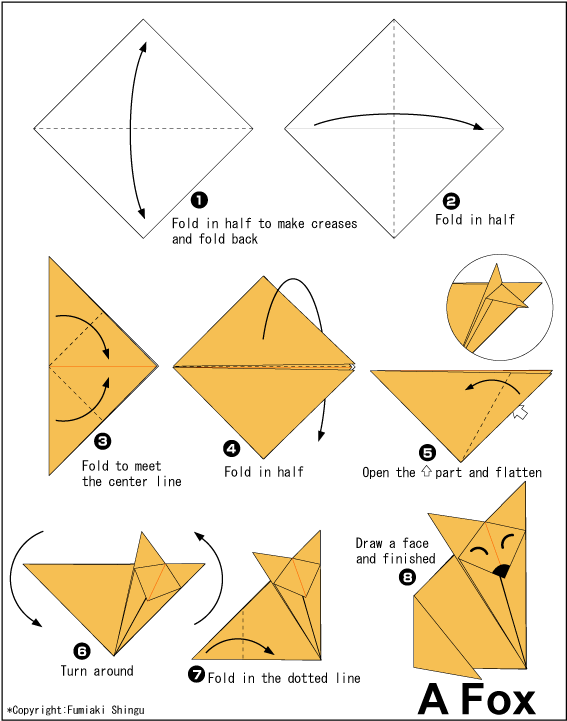
A Fox is our next creature. It uses lots of triangles and is fun because you can draw a face on him!
This lesson was developed for an elementary school fourth grade class that was split up because some students were participating in a Detriot City Choir. There were twelve students left in the class after the rest of them went to choir practice.
These students, while enthusiastic about art, had a mixture of disciplinary problems. Something their teacher struggled with frequently was students following directions. So I developed this lesson to engage them in an activity they were excited about and that would build their listening skills.
This is an activity that requires a lot of assistance and support from the teacher, so it is much more effective when done in smaller groups. I have thought about doing this lesson with a larger group by teaching the origami creature to students who finish a project early. Then having those students peer teach their own small group of students. This would help them practice listening skills, learn to respect their peers, and use the proven effectiveness of peer to peer tutuoring.
One student enjoyed making the foxes so much he made his own pack!
Guided Practice: This next origami creature can be made during the same lesson or at the next lesson depending on how quickly the students are getting it. Now we are gonna try making a fox! Once again I will guide the students through each fold assisting when needed and reviewing and checking for progress after each step. Example checking for understanding questions: Whose second fold looks like a diamond? Is anyone having trouble with this fold? If you are not ready to move on to the next fold please raise your hand.
Guided Practice: This next origami creature can be made during the same lesson or at the next lesson depending on how quickly the students are getting it. Last we are gonna try a crane. They can be really difficult so let's get our ears on and ready to listen. Crane’s can be especially difficult so we will go slower and pace ourselves. Using questions and dialog to assist as well as walk around to help students who are struggling. From fold six to fold seven our crane should go from looking like a square to looking kind of like a sparkly diamond. The number eight fold can be tricky so let’s take our time using gentle hands. Raise your hand if you need some help or ask your tablemates for some cooperation if you think you missed something.
Closure:
Cross Curriculum: Now we should all have a fox. Does your fox look like this? Here is where I will address any origami creatures that may have gotten off track. Pointing out that listening for directions is key and that they should take home their work and some instructions and try again. You all did a great job listening and following directions! Now we're gonna look over our origami creature and find some fractions and some geometric shapes.
I will draw a few examples of geometric shapes on the board and lead a question and answer discussion about fractions and geometric shapes. Who can tell me what fraction we created by folding our paper the first time? Can someone tell me any other fractions we created when we folded our origami creature? Okay now let's look at our fox. Can anyone identify a geometric shape for me? Do you see any triangles? What kinds of triangles do you guys see?
I will repeat this discussion again with the other two origami creatures we created when they are completed, as they may take another class period or two to get to.
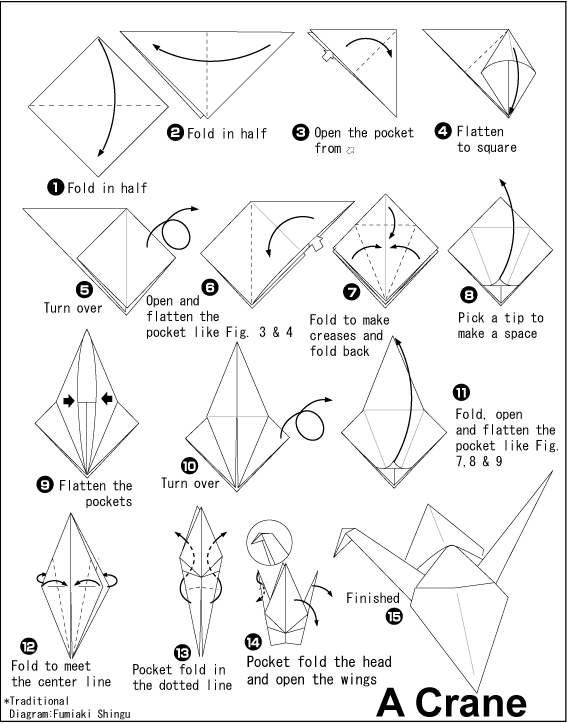
We finished with Cranes because they are an iconic origami creature. They were pretty challenging but the students were excited to tackle the task.
Review Goals: I will go over objectives and goals for the lesson and review cross curriculum concepts as well as offering glow/grow comments on behavior. So now you guys can make three different origami creatures! And you can identify mathematical principles within your origami creation. I want to thank you for being good listeners today and following directions so well.
Dismissal: Now it is time to line up. I am going to call you to get in line by table. Please line up in alphabetical order leaving space for the person in front and behind you.
References & Resources:
Polk (n.d). Retrieved March 12, 2015, from http://polkdhsd7.sharpschool.com/staff_directory/p_b_s_behavior_intervention
Handouts are attached for printing.
Rubric is attached for printing.
Professional Responsibility:
Teacher Reflection can be found here:

